Saturday, January 18, 2025
Yet another post about Composition?
Is it technical or vision that makes a good photo.
It's both but great composition can be ruined by poor technically executed photo. Like wise a technically executed photo can be boring.
I believe minor technical errors will be ignored by a strong composition.
Searching my blog for "composition" will have many posts.
This link has another view -> I'm against teaching composition rules. Rigorous following on the rules of composition leads to a lack of creativity.
I believe that they are guides but it is more helpful to actually show examples of good composition.
This discussion from Light Stalking is more informative than "rules" https://www.lightstalking.com/composition-mistakes/
Thursday, January 16, 2025
Photo and related topics
1. What can you do with Chachkas? https://theexit270.blogspot.
3. Next week's photo challenge is to take a new photo(s), up to 3, that creates a visual hook. "The best visual hook is one that resonates with the viewer on a personal level."
Please put your photos in the folder here -> https://drive.google.com/drive/folders/16e4L_6TZkiCBVOxHdvKGoqj2mvv_wg-V
4. Using Lightroom Web I created this for a Vermont photography club , https://adobe.ly/42batQ0.
Clicking on an individual photo and click the info and comment icons to see the metadata and make comments.
5. A way to get better -> https://www.matiash.com/blog/delete-your-photos
5. A way to get better -> https://www.matiash.com/blog/
Thursday, January 9, 2025
Photograph a sign
After a photography meeting I asked members.
For next week's learning task. Take interesting photographs of a sign, a single sign. Show your best 3 and only 3, for review during next week's meeting.
Use your creative juices to create photos as compelling as possible. Think of color, monochrome, shadows, angles ...
Larry, what's the point of "the sign"? It's not the sign it's about seeing. These links may help.
https://youtu.be/znhXJ-nzogg?si=leyVXhepQZWlbUqA
And
https://theexit270.blogspot.com/?m=1
Tuesday, January 7, 2025
The Bloody Rules of Composition
Often I don't explain properly.
Yes I agree that the "rules of composition" are important.
What I take issue with is the way they are taught. I much prefer to suggest that a photo may look more pleasing if;
You moved ??? right, left, up, down
it would be better if the eyes were ???
Should the ??? have room to move ...
Would it be better if the ??? lead to the ???
Would it be more pleasing if ??? was framed with ???
Would it be better if the ??? was looking/coming toward you
Does the ??? block the viewer(s) to looking to ???
I believe that guiding the photographer to a better composition is better than quoting a rule. Quoting a rule is easy teaching and understanding is more difficult.
I often prefer to discuss composition issues with the "failures" of FB and other online photos. This also provides where we can discuss the background, subject size within the frame and distractions in a more non threatening way.
Friday, January 3, 2025
Several photography videos
Noise that I found very helpful and interesting.
Stop fooling with settings by Simone D'Entremont -> https://youtu.be/znhXJ-nzogg?si=DfxX94jrSwjGu-4A
Compositioning images in Photoshop by Anthony Morganti ->
https://youtu.be/p4cE-VaY86s?si=aNO1zWJULfHNHBxI
Using Lightroom Web to share your photos by Brian Matiash ->
https://youtu.be/CFyFhLJ-Zsg
Sunday, December 22, 2024
Merry Christmas and a Happy New Year
For all that have visited my blog
Merry Christmas and a Happy New Year
I hope you have found something of value that has assisted your photography.
Thank you for visiting.
Saturday, December 21, 2024
Lightroom Classic import (Julieanne Kost's Blog)
If you are new to Lightroom Classic or would like a refresher this is worth a view of the videos.
Julieanne's blog has additional information https://jkost.com/blog/ you may want to review.
OVERVIEW & IMPORTING PHOTOS
- (2024) An Overview of the Lightroom Classic Interface
- (2024) Importing Photos Form A Camera Card into Lightroom Classic
- (2024) Importing Photos from a Hard Drive into Lightroom Classic
- (2024) Tips for Importing Files into Lightroom Classic
- (2024) The Embedded Preview Workflow in Lightroom Classic
- *Quick Tip – Why Does the Photograph’s Preview Change in Lightroom Classic After Import?
- *Quick Tip – How to Stop Lightroom Classic from Switching Folders After Importing Files
Monday, December 16, 2024
Think Rolls of Film.
In Scott Kelby's book "Crush the Composition" he wrote "'Then they start working the scene that’s in front of them and maybe that means taking 20 shots, or maybe that means taking 100, but they keep doing it until they can look at the back of the camera and say, “Nailed it!” Only then do they move on to the next scene or location and start the process of seeing and experimenting all over again."
Of course film is your card or cards in your digital camera.
Back in the day you had 24/36, or less, rolls of film. When you worked the scene did you need to actually take photos, wait for the processing and then review the negatives to select those to print?
Now in fast paced action, or perhaps street photography, burst shooting has it's place. But when you're working the scene do you need to take 20 or more shots? Maybe not. Slow down, use your eye, viewfinder, to visualize the photo.
Yes I often take many photos at an event because I'm looking for those that are unique. The candid shot with the unique expression. The those without the pasted on smile or expression.
Of course YMMV.
Thursday, December 12, 2024
December 2024 Lightroom updates
And from Lightroom Queen https://www.lightroomqueen.com/whats-new-in-lightroom-2024-12/I a using Lightroom desktop and the following video discusses updates
https://youtu.be/6akSZ47_EnA?si=KGpk1dIWig6k1jQX&sfnsn=mo
Monday, December 9, 2024
Stop it, stop it, stop it!
Stop it, stop it, stop it! Posting your pictures on Facebook, Flickr, 500px or ANY website with those two horrible words – Constructive Criticism – is NOT helping your photography
Read more at www.JoeEdelman.com: STOP asking for Constructive Criticism on your Photography https://www.joeedelman.com/constructive-criticism
In the article Joe Edelman wrote "Photographers are not allowed to just post a picture and say CC Welcome. Each post must contain details. Yes — the basic shutter speed, aperture, lens, ISO stuff. Also lighting, types of gear, modifiers, and placements. But that’s not the important stuff – all that technical crap is just reference data. The important part of the post is where the photographer explains WHY they took the picture. What was the intended purpose of the shot? Is the photographer happy with the shot? How about the subject – were they happy? If it were possible to revisit the scenario, what would the photographer do differently to improve the photo? And lastly, photographers are encouraged to ask a specific question about their own photograph so that those viewing it have a sense of how they can best help."
I was leading a discussion group about Critiques of photos. When I suggested we should not concentrate on the "rules of composition" but understand the Why the photo was taken, I was shouted down.
You have to know the "rules" before you break them. If they are new they need the rules to get a good photo.
Years ago, before I read this, when I attend one Camera Training Club meetings the first critique of others photos I almost puked when another member voiced "it didn't follow the rule of THIRDS" .
Another time after a field trip one of my photos was told to remove the white dot on the night scene. Another member said, That's Venus I think he wanted it.
Just say'n.
Sunday, December 8, 2024
Composition. What's important?
After watching 60 Minutes Meet Khanmigo: the student tutor AI being tested in school districts.
I wondered how would Google Gemini answer asked "As an instructor What actionable questions should I ask of photos"
Then "Based on the proceeding what are most important"
All the answers addressed what we have, as photographers, have been told, watched and read.
Then I asked "What non photographers consider a great photo?"
The answer "While photographers may focus on technical aspects like exposure, composition, and depth of field, non-photographers often appreciate a photo based on more emotional and aesthetic qualities. Here are some common factors that non-photographers consider when evaluating a photo:
Emotional Impact:
Does the photo evoke a strong emotion?
Does it tell a story or evoke nostalgia?
Does it make the viewer feel something?
Visual Appeal:
Is the photo visually pleasing?
Does it have a strong composition and interesting subject matter?
Are the colors and contrast striking?
Clarity and Sharpness:
Is the photo clear and well-focused?
Are the details sharp and easy to see?
Originality:
Is the photo unique and different from others?
Does it offer a fresh perspective or a new way of seeing something?
Simplicity:
Is the photo simple and easy to understand?
Does it avoid clutter and distractions?
Ultimately, a great photo is one that resonates with the viewer on an emotional level. It should be visually appealing, easy to understand, and evoke a strong reaction."
I'm not suggesting that technical aspects are not important because they are important.
What I'm suggesting is that non photographers evaluate photos much differently.
We photographers must consider making an impact with our photos.
Tuesday, December 3, 2024
Photograph your foot
I initially wrote this in a post to another club. I created the blog post because I met others who hadn't picked up their cameras for a few years.
I believe they can jump start their photography. Even today I take photos of my foot to reinforce my understanding.
It's handy.
It's about 5' from your camera when sitting in your recliner.
Ok, but why?
It's a learning tool.
When watching TV and the commercials on pickup your camera. Take a photo of your foot.
Why? It's not about your foot, it's about learning. Your camera, DoF, Focus area, Focal length, manual focus, noise, focus point, Aperture, shutter speed, program, auto, ISO, and more
Why? It's easy, you don't have to travel.
Do it with purpose. You could actually learn.
Sunday, December 1, 2024
Choose Your Aperture
In a recent sippet from The Grid ( about 30inutes in) got me thinking how to choose the Aperture.
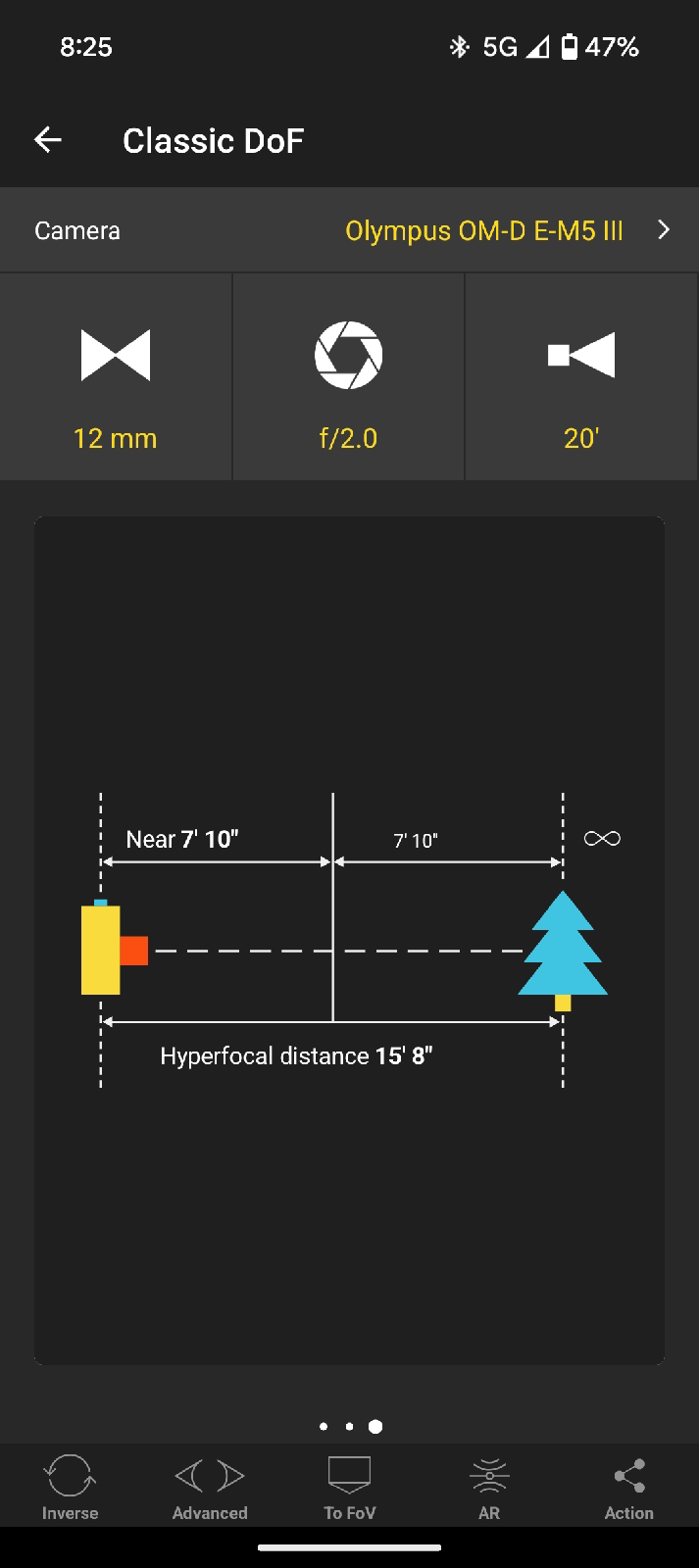
Usually I desk check to consider the Aperture I'll use considering my expectation of the scene. I use Photopills app on my phone. You may use this web version.
As an example I wanted to that light trails of lighted Disc Golf. I wanted to use my 12mm f/2.0 lens. Since there is no way I could focus on the dark what could I do?
I used Photopills DoF and setup my camera type. f/2.0 then estimated the subject distance to the camera of 50 ft.
That didn't work since the near distance was 49.+ ft. So what if the lighted Disc lands say 10ft from my camera? Using a subject of 20 feet gives me a near Dof about 9ft and a far of infinity.
The result yes but some of the discs landed out of the Depth of field in front so they are not sharp.
To me it's all about "acceptable" sharpness.
UPDATE(20241126) - Hyperfocal distance
Of course YMMV.
Subscribe to:
Posts (Atom)